

Smart Living 2026: How to Run a Modern Mansion Without Breaking the Bank
Building your dream home in the Makhado area is Phase 1. But Phase 2 is actually living in it. In “Big 2026,” a modern house is like a small factory—it produces its own power through solar and its own water through a borehole. But if you don’t manage these systems correctly, your “Mansion” will become a money pit.
Living smart in 2026 isn’t about being stingy; it’s about being strategic. It’s about knowing when to boil the kettle and how to keep your expensive batteries safe. Here is the masterclass on managing a modern, high-value home in the village.
The Energy Balance: Managing the “Heavy” Killers
We all know that solar is amazing, but it has its limits. In a modern home, the biggest “power killers” are the things that create heat—kettles, geysers, and stoves.
No Strict Rules, Just Smart Choices:
In a 2026 mansion, you don’t need to live like you’re camping. You don’t need strict rules, but you do need smart appliances.
- Solar Geysers: This is a non-negotiable. By using a solar geyser, you take the biggest power consumer off your electrical circuit. The sun heats your water for free, leaving your batteries to handle the lights and TVs.
- The Kettle Strategy: We still use the electric kettle, but the secret is frequency. We don’t use it back-to-back. By spacing out the “heavy” tasks, you give your inverter time to breathe and prevent the system from tripping.
The 2026 Legal Trap: Solar Registration & Compliance
As of March 2026, the South African government and NERSA require all solar rooftops—whether grid-tied or off-grid—to be registered. Failing to do so can result in a fine of over R6,000.
- NRS 097-2-1 Compliance: When you buy your inverter, ensure it is on the Approved Inverter List. If your inverter isn’t NRS 097-2-1 compliant, the municipality can legally disconnect your house from the grid.
- The Solar CoC: You must have a Certificate of Compliance specifically for your solar installation. Without this, your homeowner’s insurance will reject your claim if there is a fire or a lightning strike.
Water Management: The JoJo Tank as a “Water Battery”
Having a borehole is a blessing, especially when municipal water is unreliable. But running a borehole pump every time you turn on a tap is a waste of electricity and puts too much stress on the pump motor.
The Storage Secret:
The smartest setup for 2026 is to use your JoJo tank as a storage battery for water. Instead of the pump kicking in every time you wash your hands, you should pump water into the tank during the day when your solar panels are producing maximum “free” energy.
- Dry-Run Protection: To protect your 1.1kW pump, you must install a Digital Dry-Run Protector. In the dry Limpopo seasons, if your pump runs while the water table is low, the motor will burn out. A protector (costing around R2,000) saves you a R15,000 repair bill.
Thermal Management: Preventing Battery “Thermal Runaway”
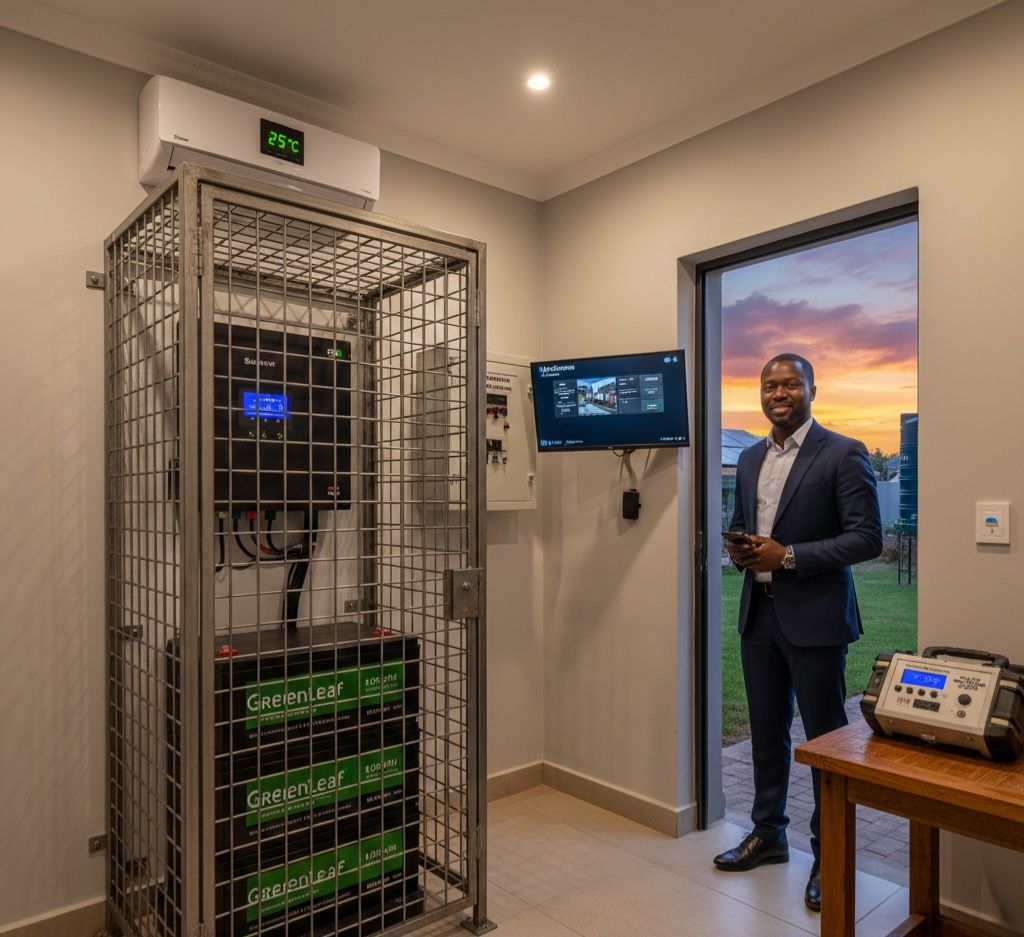
Limpopo is hot, and heat is the enemy of Lithium (LiFePO4) batteries. If your batteries get too hot, they can enter a state called “Thermal Runaway,” where they overheat internally and can even catch fire.
- The 25°C Standard: Your “Power Room” needs to stay cool. Use passive ventilation (air bricks) and active ventilation (extractor fans).
- The Internal Room Advantage: This is why we recommend an Internal Power Room. Keeping your batteries inside the house, away from the 40°C garage heat, can double the lifespan of your R100k battery bank.
Eskom vs. Solar: The Hybrid Reality
Let’s keep it 100—as a country, we are still stuck with Eskom. In 2026, the Hybrid System is the king of the village. You use solar to reduce your bill by 80%, but you keep Eskom for the rainy days.
- Smart Meters: By March 2026, Eskom aims to have over 2 million Bi-directional Smart Meters installed. These allow for accurate billing and ensure you aren’t accidentally “feeding” power back into the grid illegally.
- The Financial Move: Investing in solar isn’t just about avoiding load shedding anymore; it’s a financial move to stop the bleeding from high electricity tariffs.
The “Vampire” Loads: Hidden Power Eaters
In a mansion, small things add up. Your CCTV NVR, Wi-Fi Mesh system, Electric Fence, and Gate Motors are “Vampire Loads.” They stay on 24/7.
- The Calculation: These small devices can eat up to 1.5kWh to 2.5kWh of your battery every single night. When designing your system, don’t just account for the lights; account for the “brain” of the house that never sleeps.
Security: Protecting Your “Power Room”
Your batteries and inverters are the most expensive items in your house. They are a target for thieves.
- Steel Cages: If your inverter is in the garage, it should be locked inside a custom steel cage that is bolted into the floor and wall.
- Vibration Sensors: Link your solar room to your alarm system. If someone tries to grind the cage or move the batteries, the alarm should trigger immediately.
The “Tech Premium”: Increasing Resale Value
Does a smart, independent home actually sell for more? Absolutely.
- The R300k Premium: While basic solar adds value, a “Smart Integrated” home—one where the owner can monitor water levels and battery health from an app in Gauteng—commands a much higher price.
- Future-Proofing: Buyers in 2026 are looking for “Future-Proof” solutions. A house that comes with its own water and power is a “Safe Haven” investment.
Living in a modern home in 2026 is about being the “Manager” of your own utilities. When you balance your kettle usage, store your borehole water in a JoJo tank, ensure your system is NRS 097 compliant, and protect your batteries from the Limpopo heat, you are winning.
You get to enjoy the “mansion lifestyle” without the stress of high bills or security fears. Smart living is the ultimate luxury, and it starts with the choices you make during construction.
This article reflects personal experience and is not professional engineering or financial advice.