

Finishing the Dream: How to Tile, Plaster, and Paint Your Home for Maximum Value (Without Breaking the Bank)
In the villages around Makhado and Vhembe, we have all seen that one house: it stands plastered but unpainted, or the lounge has beautiful tiles while the bedrooms are still bare cement. It’s a dream on hold, and often it stays that way because the “finishing phase” cost more than the owner expected.
The truth is, the foundation is for the house, but the finishing is for the owner.
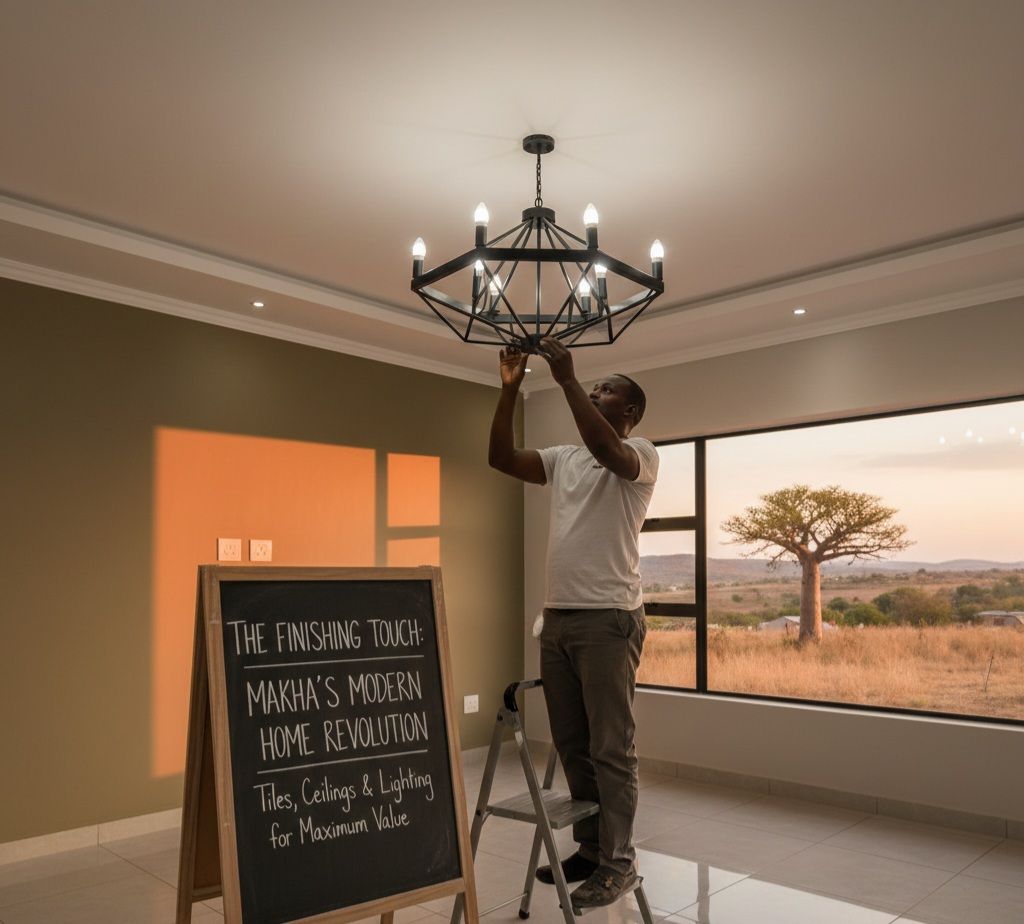
The truth is, the foundation is for the house, but the finishing is for the owner. If you get this stage wrong, you don’t just lose money—you lose the “mansion” feeling you worked years to build. In “Big 2026,” finishing a home requires a strategy that balances luxury with the harsh Limpopo climate. Here is how to cross the finish line without breaking the bank or your heart.
The Tiling Trap: Why “Half-Half” Destroys Value
The most common mistake in Elim and Mpheni is trying to save money by putting expensive porcelain in the sitting room and cheap ceramics in the bedrooms.
The Danger of Batch Discontinuity:
Tiles are made in “dye lots.” If you buy 50 boxes of “Sandstone Beige” today and go back to Builders or Cashbuild in 4 months for the rest, the new boxes will likely be from a different batch. The color might be 2% darker, or worse, the size might be 1mm smaller. On a long floor, that 1mm makes your grout lines look like a zig-zag.
The Pro Rule: Save for 6 months if you have to, but buy every single tile for the whole house at once. Consistency is the hallmark of a high-value home.
Plastering: The Secret is in the Sand
In the hot Vhembe sun, bad plaster will crack within weeks. Most people blame the builder, but the culprit is usually salty or clay-heavy sand. * The Fix: Invest in “Washed” plaster sand. It has minimal silt content, which prevents the plaster from shrinking and “webbing” as it dries.
- The Finish: Use a steel float for a glass-smooth finish. Remember, paint is not a filler. If your plaster is wavy, modern silk or low-sheen paint will actually make those bumps look shinier and more obvious.
Ceilings: The “Polokwane” Seamless Standard
If you are building in 2026, the old yellowing PVC “strip” ceilings are out. For a truly modern look, you want a seamless Rhino Board (Gypsum) ceiling.
Because it’s hard to find specialists in every village, we actually found our installer online from Polokwane. He used a “Rhinolite” plaster finish to hide every join. When you add LED downlights and a modern chandelier with G9 LED bulbs (which use 90% less power than halogens), your ceiling becomes a work of art that doesn’t drain your solar battery at night.
The 2026 Color Forecast: Earth Tones are King
In “Big 2026,” we are moving away from stark whites and boring beiges. The trend is “Grounded Luxury.” * The Palette: Look for colors like Soft Suede, Sand Olive, and Mushroom. These warm neutrals handle the bright Limpopo light better than “Cool Grey,” which can look blue and cold in our climate.
- The Accent Wall: Instead of painting a dark wall, use Stone Cladding on your porch pillars. It holds up against the sun and adds a layer of texture that paint can’t match.
Paving: Your “Red Dust” Insurance
You can spend millions on a house, but if the yard is still red dust, it will never feel finished. Red dust is the enemy of porcelain tiles; it acts like sandpaper, scratching the surface every time you walk inside.
Bevelled Pavers are the standard for 2026. They create a clean, estate-like look and stop the dust from entering your home. If the budget is tight, pave a 1.5-meter “apron” around the house first—it protects your paint from mud-splatter during summer rain
Frequently Asked Questions (FAQ)
- Q: Is Gamazine still modern in 2026?
- A: Honestly? It’s starting to look “old school.” While durable, it’s hard to clean and difficult to change. Smooth, high-quality paint is the preferred finish for a modern “mansion” look.
- Q: Should I take a loan to finish my tiles?
- A: Nah. The interest rates in 2026 make loans a trap. It is better to have a “cement floor” for 6 months while you save cash than to have beautiful tiles and a bank manager calling you every day.
- Q: Which light bulbs are best for a solar-powered home?
- A: Stick to LED G9 or E27 bulbs. They provide “Warm White” light (below 3,300 Kelvin), which makes earth-toned walls look rich and expensive while using very little of your battery’s capacity.
Conclusion: Build for the Future
Building a home is a marathon. Don’t let the pressure of “finishing fast” force you into cheap choices that you will regret in three years. If you have to wait to buy the right tiles, wait. You are building a legacy, and in 2026, quality is the only thing that stands the test of time.
This article reflects personal experience and is not professional architectural or financial advice.