

The Capacity Anxiety: Why Your Solar Battery is the Real Heart of Survival
When people talk about solar, they show off their shiny rooftop
When people talk about solar, they show off their shiny rooftop panels. But after living through extended power faults in the Makhado Local Municipality, I’ve learned the truth: the panels provide the power, but the battery determines your survival. For South African homeowners, especially those dealing with the 3-day transformer faults we experience here, you need to stop obsessing over the watts of your PV panels and start focusing on the stored kilowatt-hours. The battery is the heart of your security and comfort, and compromising on it is the single biggest mistake you can make.
The Reality of Capacity Anxiety: The 3-Day Survival Strategy
The reality of power management in our communities is that you are constantly fighting two different battles: predictable load shedding and unpredictable local faults. When you live in a village setting, the latter is the true measure of your battery’s capacity. While the national grid might follow a schedule, our local infrastructure in Limpopo often suffers from aging transformers. When that transformer blows, you aren’t just looking at a 2-hour outage; you are looking at a 72-hour survival mission.
In my house, we have developed a strict “Crisis Protocol” for these moments. The first thing we sacrifice is the TV. While everyone loves to watch the big screen, the reality is that in 2026, you can enjoy most of your entertainment on your cellphone, which uses almost zero battery compared to a 55-inch LED screen. We keep the fridge running because food security is non-negotiable, but we move to “The Wood Pivot” for everything else. We use firewood for cooking and heating water, humbling ourselves as we wait for Eskom technicians to arrive at the local substation. This combination of ancient survival methods and modern lithium technology is the only way to make a standard battery bank last through a prolonged village blackout. We don’t panic when the battery hits 40% during normal load shedding, but when it’s a transformer fault, that 40% becomes a countdown to darkness that requires immediate discipline.
The Killer Appliance: The Modern Hisense Fridge Secret
My biggest silent capacity killer used to be the fear of the fridge. However, I’ve learned that the type of fridge you own changes the entire solar equation. I use a modern 370-liter Hisense fridge. Unlike the old “battery killer” fridges of the past, these modern units are much more efficient. Many people anticipate that the fridge will drain the battery instantly, but my experience shows that if you have a high-quality unit, it is actually quite manageable. It doesn’t drain the battery as fast as people interpret; in fact, on a sunny day in Makhado, the panels cover the fridge’s consumption with ease.
During a transformer crisis, which luckily only happens once or twice a year in our area, we do make use of the fridge’s “Holiday Mode” or specific energy-saving settings. We also become very disciplined about how often we open the door. Every time you open that fridge in the Limpopo heat, you are letting out the “cold” that your battery worked hard to create during the day. By leaving it closed and using its modern inverter technology, we ensure our food stays fresh without killing our night-time reserves. This is a crucial point for anyone starting their solar journey: don’t just buy panels; check your fridge’s energy rating first. A modern inverter fridge is essentially a “solar-friendly” appliance.
The Race Against Time: The “Generator-Solar” Hybrid Workaround
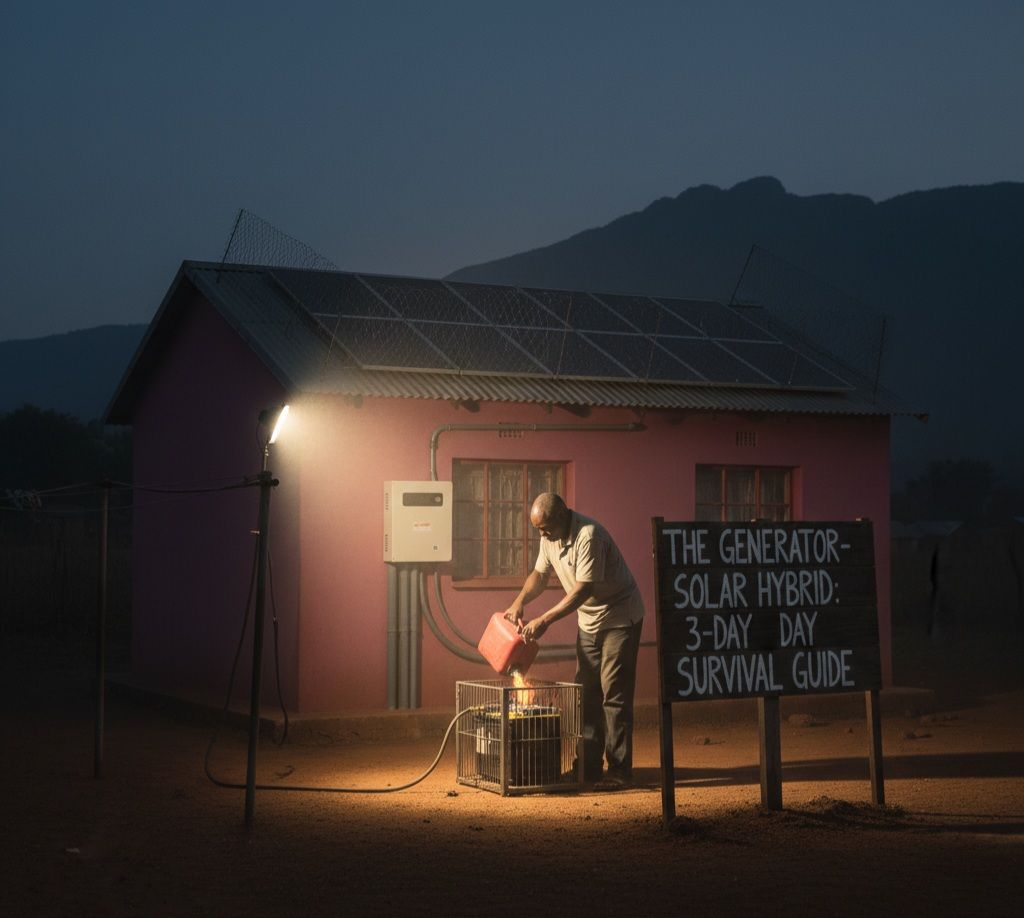
The brutal reality of South African load shedding is that electricity returns for a short burst—often 2 or 4 hours—before going off again. When the grid returns, the battery only charges a little but not fully before the next outage. This is called partial charging. But what happens when the grid doesn’t come back at all for three days? This is where the “Generator Backup” comes in, even for solar users. Most people think it’s an either/or choice, but in a village where faults last for days, a hybrid approach is the only way to survive.
I’ve had to run a generator only once during a particularly bad fault. We ran it for five hours to top up the battery bank. In 2026, with petrol prices sitting at R19.21 per liter, spending that money on 5 liters of fuel (roughly R96) feels like “burning money,” but it is a necessary evil to protect a R60,000 solar investment. The noise of a generator is a major disadvantage, and the fuel cost is a pain, but it provides that “emergency bridge” when the sun isn’t enough to reach 100%. Using a generator as a “fast-charger” for your lithium battery during a crisis is a high-value strategy that ensures your house stays powered when the village stays dark for a week. It’s an expensive 5 hours, but it prevents the total collapse of your home’s energy system.
The Cheap Battery Trap: A Financial and Technical Certainty
My old technology teacher had it right: “If you buy something cheap, expect it to not last longer than the expensive one.” In Makhado, our daily cycling means a cheap Lead-Acid or Gel battery is effectively dead within two or three years. You will pay to replace it three times before a quality Lithium battery (LiFePO4) even begins to degrade. The higher upfront cost of Lithium is justified by the lower Cost Per Year. If you choose a quality brand, the technical management becomes much easier because the Battery Management System (BMS) handles the heavy lifting.
When you use a high-quality battery, even high-draw appliances like a microwave don’t cause the system to “scream” or the inverter fans to go into overdrive. If I use my microwave for a few minutes to heat up food, the battery percentage might decrease a bit, but it doesn’t trigger alarms. This is the difference between “buying a battery” and “buying peace of mind.” Cheap batteries can’t handle the “surge” of a microwave or a kettle; they suffer from “voltage sag” which causes your lights to flicker and eventually kills the battery cells. If you want to use your kitchen like it’s “normal times,” you cannot afford to go cheap on your storage chemistry.
Security and Survival: The “Invisible” Placement Strategy
The high temperatures and criminal element in Limpopo mean your battery’s security and placement are non-negotiable tasks that directly affect your warranty. Limpopo is hot—we regularly hit 33°C. Batteries hate heat. High temperatures accelerate the chemical reactions inside the battery, leading to quicker degradation and increased risk of “thermal runaway.” My specific measure to combat this is passive cooling combined with high security. I keep my battery in a small back room, positioned so that nobody can see anything from where they are standing outside.
To keep the battery healthy, we keep the windows in that back room open at all times. This simple act of ventilation makes the battery “feel normal” and prevents the heat from building up in a confined space. There is also a psychological and security aspect to this. While crime in my specific area is low, you still have that feeling of “what if they break in?” especially when your house is the only one glowing in a dark street during load shedding. I have a steel cage for the battery just to be sure. You never know what a “village thief” is thinking when they see a house that looks like the electricity never left. You must protect your equipment from both the heat of the sun and the eyes of the street.
The Ultimate Upgrade: Why the 10kWh Dream is Necessary
The emotional payoff of solar is eliminating the stress of load shedding. My biggest regret is that I did not buy the ultimate freedom from day one. I started with a smaller system, but I quickly realized that “managing” power is almost as stressful as not having it. My final goal is a massive 10kWh battery bank. This is the “Magic Number” for a 4-room house because it allows you to stop checking the screen. It provides enough buffer to handle a fridge, lights, TV, and even the microwave without ever feeling that “disappointment” when the sun goes down during a transformer fault.
If you have kids, a 10kWh system is a must. You want them to be able to watch TV and live a normal life regardless of what Eskom is doing. For me, that 10kWh bank means using the microwave like it’s normal times. I bought solar to eliminate power management stress, but I was sold a system that required constant checking of the state of charge. Investing in a high-capacity, high-cycle, fast-charging battery is the only way to genuinely achieve the freedom you paid for. Whether you are using a Hisense inverter fridge or a generator for emergency charging, the goal is always the same: food security, home security, and the dignity of a house that stays bright when the rest of the world goes dark.